

Running a restaurant is exciting but keeping it running efficiently is hard.
A single equipment issue can slow production, impact consistency, and increase repair costs. However, the truth is that most restaurant problems don’t start in the kitchen, but rather with what’s not being managed behind it.
Too many restaurants treat maintenance as an afterthought. When something breaks, they call a technician, pay the bill, and move on without any preventive maintenance planning.
That cycle quietly eats into profit, downtime costs money, emergency repairs cost more, and small issues ignored long enough become big, expensive ones.
The problem is that there’s no real restaurant facilities management process in place to keep things on track. Until that changes, the same breakdowns and costs will continue to recur.
It’s Not the Equipment, It’s the System
Everyone loves to blame the equipment. But most of the time, it’s not the equipment that’s broken, it’s the system behind it.
Because when you strip it down, restaurant facilities management isn’t about fixing things. It’s about preventing them from breaking in the first place.
A lot of restaurant owners don’t realize they have a facilities management problem and have built a business on reacting instead of running a plan. They rely on a mix of handwritten notes, last-minute calls to technicians, and gut instinct to keep the place running.
The restaurants that run smoothly are the ones that treat facilities management like a business function, not an afterthought. They know exactly when each piece of equipment was last serviced. They know who to call before something breaks, not after. They use structured facility management services or smart tools to track maintenance, monitor assets, and stay ahead of downtime.
Because the truth is, every piece of restaurant equipment has a shelf life. But when you manage it right, you can stretch that life, control your costs, and keep your team focused on what actually matters: delivering great food and great service.
Good restaurant facilities management doesn’t just keep things running, it keeps your restaurant earning.
The Real Cost of Poor Facilities Management
1. Constant Breakdowns Disrupt Operations
When maintenance is handled reactively, equipment failures become part of the daily grind. A fryer stops heating evenly, a walk-in cooler struggles to hold temp, and suddenly the kitchen flow is off balance. As a result, the staff has to improvise, food prep slows, and quality starts to slip.
In one US industry report, nearly 46% of operators said unplanned equipment downtime was one of their top operational challenges. That’s time and labor lost to problems that could’ve been avoided with preventive care.
2. Rising Repair and Maintenance Costs
Emergency fixes are far more expensive than routine maintenance. Depending on the equipment and urgency, a single breakdown can cost anywhere from $500 to $5,000 in parts and labor.
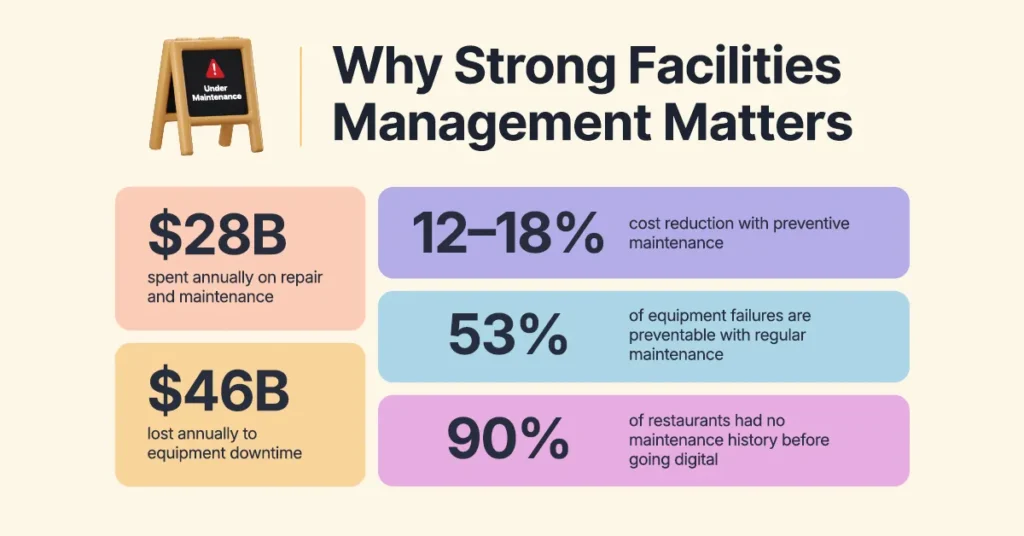
Cooking and refrigeration equipment costs have climbed sharply in recent years by as much as 20%–30%, due to parts shortages and supply chain delays. Restaurants that use preventive maintenance cut repair costs by 12–18% compared to those that wait for things to break.
Poor tracking makes it worse. Many operators don’t have complete service histories for their assets, which leads to repeated fixes on the same units with no data to show what’s really costing them.
3. Downtime and Revenue Loss
Every hour that critical equipment is down cuts directly into revenue. During busy service hours, even a short outage can mean hundreds of dollars in lost sales.
Downtime can cost restaurants between $800 and $1,200 per hour, depending on ticket volume and menu mix. Even though US restaurants already spend $28 billion every year on repairs and maintenance, they’re still losing an additional $46 billion because of equipment downtime.
4. Waste and Energy Inefficiencies
When kitchen equipment isn’t working properly, energy and food waste climb fast. A walk-in cooler that runs too warm can spoil thousands in inventory overnight, while a miscalibrated oven can cause inconsistent cooking and product loss.
Commercial kitchens use 5-7 times more energy per square foot than any other commercial space. Faulty or aging equipment can increase that usage by up to 20%, adding thousands per year in utility costs.
Preventive maintenance, including cleaning coils, calibrating thermostats, and replacing worn seals, etc. directly reduces energy waste and protects margins.
5. Impact on Staff and Reputation
Constant breakdowns don’t just drain money; they wear down teams. Every breakdown affects morale. When your team constantly has to work around broken tools or unreliable systems, frustration builds fast. Reliable equipment gives staff confidence, stability, and pride in their work, while constant chaos drives even your best people away.
The National Restaurant Association reports that replacing a single restaurant employee costs an average of $5,800. Equipment issues are one of the top operational frustrations driving that turnover.
And while guests never see the broken fryer or the cooler that failed mid-service, they feel the effects, which are longer waits, inconsistent food, and lower satisfaction. Around 60-82% of diners report they will not return after a single bad experience.
The Domino Effect
When one thing goes wrong in a restaurant, it never stays just one thing. A single maintenance issue can trigger a chain reaction that hits every corner of your operation.

1. The Kitchen Chain Reaction
When a key piece of equipment goes down, e.g., a fryer or a walk-in, everything around it slows down too. Prep gets backed up. Orders pile up. The kitchen flow turns into chaos.
Your staff starts improvising, cutting corners just to keep food moving. And that’s when mistakes such as food waste, safety slips, and inconsistent quality happen.
What started as one small repair issue turns into hours of lost production, unhappy guests, and stressed-out staff. This is why smart restaurants focus on prevention. They avoid those ripple effects by keeping equipment running smoothly before the rush ever begins.
2. Food Safety at Risk
Broken equipment doesn’t just slow you down but also puts your food safety and compliance at risk. A malfunctioning cooler, fryer, or dishwasher can compromise temperature control, sanitation, and food storage. This can result in spoilage, health code violations, and a serious hit to your credibility.
With the right restaurant facility management plan, you can track maintenance records, monitor temperature logs, and ensure every piece of equipment meets safety standards automatically.
3. Staff Morale and Burnout
Nothing burns out a good kitchen team faster than constant breakdowns. When your crew has to work around broken tools or unreliable systems, frustration builds fast. They start feeling like they’re working for the equipment instead of with it.
Investing in proper restaurant equipment repair and maintenance isn’t just about keeping machines alive; it’s about keeping your people engaged and productive. Remember, smooth systems create confident teams and chaos drives them away.
4. Customer Experience Takes the Hit
Guests don’t see the fryer that went down or the cooler that stopped holding temperature. They just notice the slower service, the uneven quality, and the stress on your team trying to hold things together.
When equipment breaks, it throws off the rhythm of the kitchen. Orders back up, communication slips, and the dining room starts to feel it. What starts as a small repair issue can quickly affect the entire guest experience. Even one rough shift can change how guests see your restaurant.
Common Restaurant Equipment Maintenance Mistakes to Avoid
Even the best-run restaurants slip up when it comes to facilities management. Most of these mistakes seem minor in the moment, but over time, they drain cash, slow service, and shorten equipment life. Here are some of the most common pitfalls to watch for:
1. Ignoring Preventive Maintenance
Many restaurants wait until something breaks before calling for service. It feels efficient in the short term, but this “reactive” approach always costs more in the long run. Emergency repairs often come with rush fees, unexpected downtime, and overnight shipping for parts.
Preventive maintenance, on the other hand, spreads those costs out, keeps everything running when you need it most, and helps in extending the lifespan of your most expensive assets. One industry analysis found that 53% of restaurant equipment failures could be prevented with regular maintenance.
2. Relying on One Technician for Everything
Having a trusted repair technician is valuable, but relying on a single contact for every type of issue often leads to inconsistent quality and slower service. Different types of equipment, such as refrigeration, HVAC, cooking, and dishwashing, require their own expertise. A generalist may be able to patch things up, but those temporary fixes often fail again within weeks.
The smarter approach is to build partnerships with specialized facility maintenance companies that can respond faster and fix issues right the first time. Not only does that reduce repeated service calls, but it also gives you a more accurate picture of your true maintenance costs.
3. No Record of Past Repairs
A missing maintenance history is one of the biggest blind spots in restaurant operations. Without maintenance history, you can’t see the patterns. E.g. the same fryer or oven could break down multiple times, costing thousands, without anyone realizing it’s more efficient to replace it.
A digital facility management system solves that problem by tracking every service request, repair cost, and vendor performance in one place. With that data, you can make informed decisions about replacements, warranties, and budgeting instead of relying on guesswork. Over time, those insights can save thousands in unnecessary repairs and downtime.
4. Skipping Staff Training
Most breakdowns start with misuse. When staff aren’t trained on how to properly clean, load, or operate key appliances, small mistakes add up to big failures. Something as simple as overloading a dishwasher, ignoring fryer oil filtration, or blocking airflow in a cooler can cause damage that leads to expensive repairs.
Consistent training sessions, backed by clear SOPs, help prevent these problems before they start. Investing a few hours in staff education can save weeks of frustration and unplanned maintenance costs down the line.
5. Mixing Manual and Digital Tracking
Maintenance tracking tends to get messy, especially across multiple locations. Some teams keep notes in a notebook, others use spreadsheets or group chats, and nothing stays updated. That kind of fragmentation kills accountability and makes it impossible to see what’s really happening across your stores.
Centralized restaurant management software fixes this by consolidating all requests, tasks, and follow-ups in one system. Every issue gets logged, tracked, and resolved visibly, which results in fewer surprises and more control over your operations.
6. Delaying Small Repairs
7. Not Cleaning Equipment Properly
One of the biggest and most common mistakes restaurants make is neglecting proper equipment cleaning. Daily wipe-downs may make things look clean, but residue, grease, and mineral buildup can accumulate inside components, filters, and coils, silently wearing equipment down. E.g., one field evaluation of commercial fryers found significant energy and oil savings when equipment and filters were better maintained. Similarly, unclean refrigerator condenser coils force compressors to work harder, increasing energy costs and risk of breakdowns.
A structured cleaning schedule with assigned responsibilities and documented checklists ensures every piece of equipment gets cleaned thoroughly and consistently. Beyond preventing breakdowns, proper cleaning helps maintain food quality, energy efficiency, and compliance with health codes, protecting both your operations and your bottom line.
Why Traditional Facilities Management Keeps Failing
Most restaurant teams think their facilities are fine until something breaks, and that’s one of the biggest operations mistakes they make. Then, the entire operation grinds to a halt. A fryer goes down during peak hours, refrigeration fails overnight, or HVAC stops working in summer heat.
This is the silent cost of traditional facilities management. It’s reactive, slow, and disconnected. Someone notices an issue, makes a call, waits for a technician, and prays it doesn’t happen again. There’s no visibility into equipment history, no maintenance tracking, and no way to predict what’s next.
The numbers paint a clear picture. Equipment downtime costs the quick-service restaurant industry roughly $46 billion each year in lost revenue. In some food operations, an hour of unplanned downtime can cost more than $30,000. Yet, only 46% of restaurant operators have any predictive maintenance plan in place. That means over half of the industry is flying blind, spending more on emergency repairs than on prevention.
The problem isn’t just with the equipment but also with the system behind it. When repairs and maintenance are tracked manually, then service records get lost, vendors aren’t monitored, and assets go unserviced until failure.
Modern restaurants need more than a repair hotline. They need integrated facility management software that connects every part of the operation into a single view. When maintenance schedules, performance data, and service costs are all in one place, you can see patterns, not just problems.
Technology makes this possible. Smart systems now let you track when each asset was last serviced, receive alerts before something breaks, and measure vendor performance across locations. This shift from reactive to predictive maintenance can reduce downtime by 35-50% improve equipment life, and cut operational costs significantly.
It’s not about replacing people. It’s about giving them the right tools to manage smarter. When your facilities team and restaurant managers have real-time visibility, they make better decisions, prevent surprises, and keep service consistent. That’s what turns facilities management from a cost center into a performance driver.
And that’s where restaurant management software comes in to automate these moving parts, connect teams, and make maintenance a proactive process instead of a last-minute scramble.
Must read: Why Restaurants Shouldn’t Ignore AP Automation Software
Key KPIs to Measure Your Facilities Management Performance
You can’t improve what you don’t measure. That’s why tracking the right KPIs helps restaurants spot inefficiencies early, reduce costs, and keep operations running smoothly. Here are a few metrics that separate reactive maintenance from high-performing systems.9
1.Average Equipment Downtime
2. First-Time Fix Rate
Tracking the percentage of problems resolved on the first visit shows how reliable your vendors are and whether your issue reporting process gives them the right information upfront. A low rate may signal poor diagnosis or the wrong service partners.
3. Maintenance Cost as a % of Sales
It helps benchmark equipment repair and maintenance expenses against total revenue. If you’re spending more than 4–6% of sales on repairs and upkeep, it’s a sign that too much money is going toward fixing, not preventing. Ideally, this should decrease as preventive systems mature.
4. Work Order Completion Time
This KPI shows how efficiently your team and vendors respond. A shorter completion time means less downtime and better operational flow. It’s also a key indicator of whether your reporting and approval workflows are working.
5. Preventive vs. Reactive Maintenance Ratio
This ratio shows the balance between planned maintenance and emergency fixes. The goal is to keep preventive maintenance above 60–70% of total work orders. The higher your preventive maintenance share, the healthier your facilities program.
6. Repeat Failures per Equipment Type
Tracking repeat failures highlights which assets are underperforming or due for replacement, helping you invest strategically instead of reactively.
How Meal Dynamics Simplifies Facilities Management
Restaurants today operate with tighter margins of around 10%, smaller teams, and higher customer expectations than ever before. That’s why relying on reactive maintenance doesn’t work anymore. Every breakdown costs time, money, and guest trust. What restaurants need is visibility, structure, and control across all their locations and assets.
That’s exactly what Meal Dynamics delivers. It’s an AI-powered restaurant management software built to handle the messy, operational side of the business, including equipment repair, maintenance tracking, vendor management, and daily checklists.
Instead of chasing service calls or juggling spreadsheets, operators get a clear picture of what’s happening across their facilities. When an issue comes up, it’s logged immediately, assigned to the right vendor, and tracked until it’s resolved.
Meal Dynamics uses AI to predict potential breakdowns before they happen. It automatically assigns the right vendors and recommends the most cost-effective repair or replacement options. Thus, no more delays or missed maintenance. All you get is a smarter, proactive solution to keep every piece of equipment running smoothly.
In addition, regular checklists and service reminders keep assets in top shape. Performance data helps identify recurring issues and high-cost equipment. Over time, this turns maintenance from a constant scramble into a data-driven process that protects profit and keeps operations steady.
Conclusion
Your restaurant is only as strong as the systems behind it.
Breakdowns aren’t random. They’re reminders that it’s time to stop reacting and start managing smarter. When your facilities are under control, everything else follows i.e., smoother service, lower costs, and a team that can focus on great food and happy guests.
Good facilities management isn’t about fixing what’s broken. It’s about building consistency, protecting profits, and keeping your restaurant running at its best.
That’s exactly what Meal Dynamics helps you do. It gives you the visibility, structure, and control to stay ahead of downtime and keep every location performing at its best.
Because when your systems work smoothly, your restaurant does too.
Want to see how Meal Dynamics can simplify your restaurant’s operations?