Restaurant margins have been getting tighter for years. Rising food costs, labor shortages, and operational complexity have made running a restaurant more difficult than ever. Owners and managers are constantly looking for ways to improve efficiency without sacrificing service.
At the same time, many industries are adopting artificial intelligence to simplify operations and reduce costs. The restaurant industry, however, has been slower to embrace it. Some operators still question whether AI is actually useful for restaurants. Others are interested but struggle to find tools that truly solve their operational problems.
The reality is that most restaurant challenges are operational. Managers spend a large portion of their day dealing with tasks like vendor coordination, repairs and maintenance requests, expense tracking, invoice approvals, and task management across locations. These responsibilities are necessary, but they leave little time for leading staff or improving the guest experience.
This is where AI is beginning to change the equation. Instead of adding another tool to manage, modern AI systems are starting to function like a digital operations manager. They help restaurants organize workflows, automate routine tasks, and keep operations running smoothly in the background.
Restaurant AI is now evolving from a simple technology tool into something far more valuable: a system that supports day-to-day operations and helps managers focus on what matters most.
The Hidden Work Behind Running a Restaurant
When people think about restaurant management, they often picture the front of the house. Greeting guests, checking tables, helping the kitchen during busy hours, or making sure service runs smoothly.
In reality, a large portion of restaurant management happens behind the scenes.
Restaurant managers in the USA typically work long, demanding hours, commonly averaging 50-70 hours a week. They spend a significant part of their day handling operational work that keeps the business running. These tasks rarely get noticed by customers, but they are essential to maintaining consistency across locations.
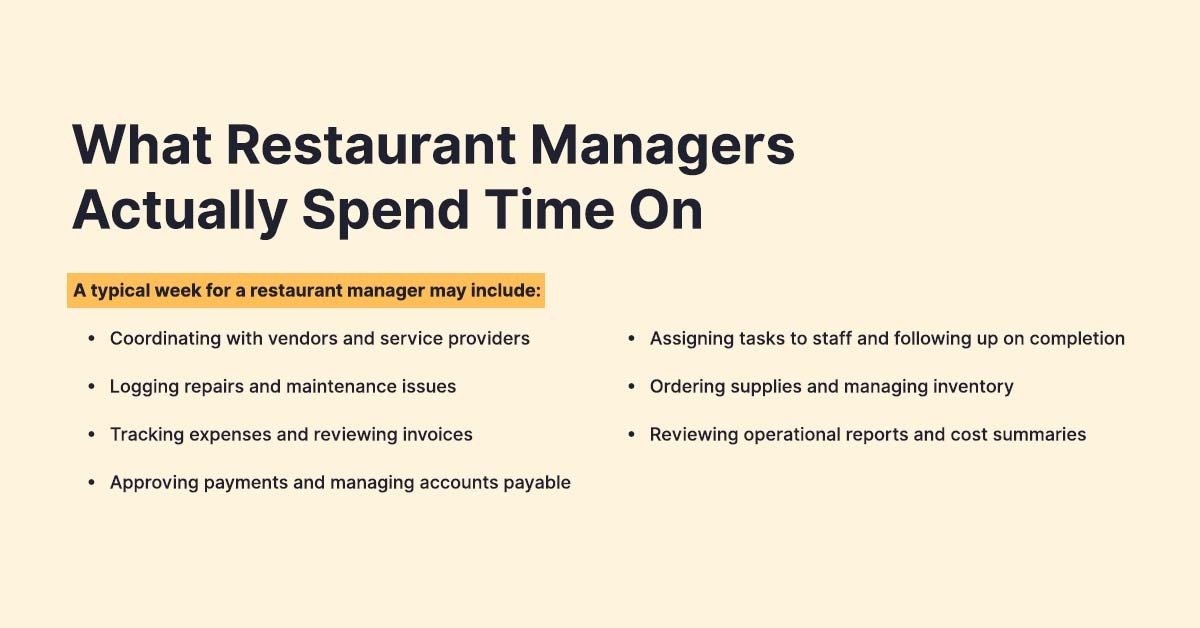
For restaurants operating across multiple locations, the complexity increases even further. Managers may need to track expenses from different stores, coordinate with several vendors, and ensure tasks are completed across teams that are not always in the same place.
Over time, these responsibilities begin to take up more and more of a manager’s attention.
Must read: How Weak Facilities Management Kills Restaurant Profits
The Operational Overload Problem
The challenge is not that these tasks are unnecessary. Every restaurant needs them. The problem is how they are managed.
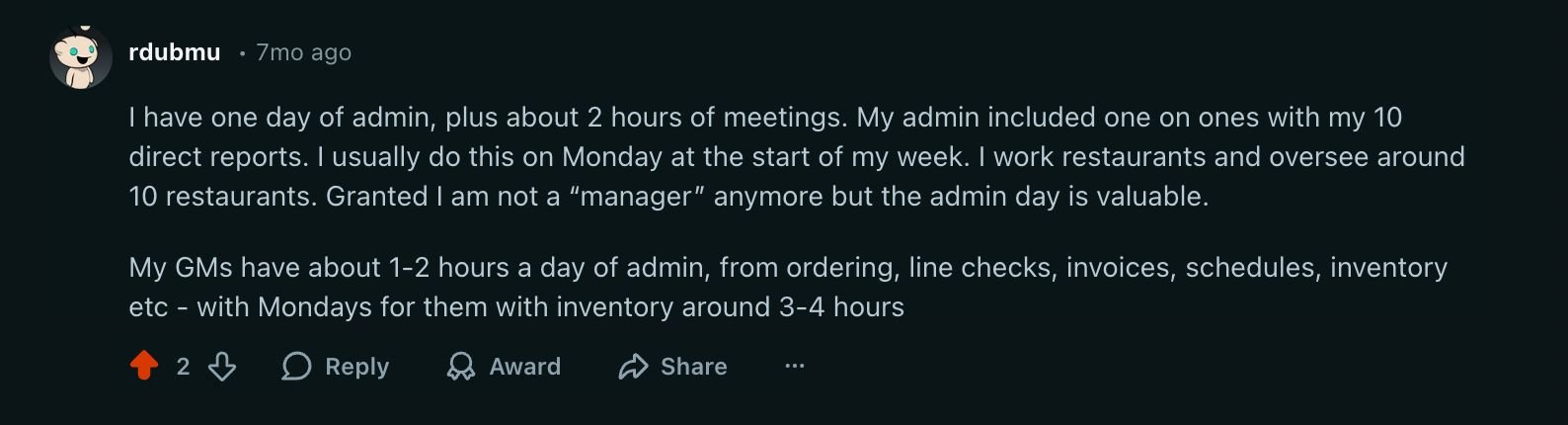
Restaurant managers typically spend a significant portion of their 50-60+ hour work week on administrative tasks, with many spending 35-60% of their time on paperwork, including payroll, inventory, and scheduling. A survey found that 96% of hospitality managers spend excessive time on admin, with 10% spending 20+ hours weekly.
Many restaurants still rely on a mix of spreadsheets, emails, messaging apps, and disconnected tools to run their operations. Maintenance requests might be shared through text messages. Vendor invoices may arrive by email. Tasks may be tracked in separate systems or not tracked at all.
As operations grow, this fragmented setup becomes harder to manage. Issues take longer to resolve. Important information gets buried in conversations. Managers spend time chasing updates instead of focusing on improving service or supporting their teams.
This operational overload is one of the hidden pressures behind shrinking restaurant margins.
How Operational Systems Became Fragmented
Most restaurants did not intentionally build fragmented operational systems. Over time, they simply added tools whenever a new need appeared.
A spreadsheet might be used to track expenses. Vendor invoices arrive through email. Maintenance issues are reported through messages or phone calls. Tasks are shared in chat groups or written down during shift handovers. Payment approvals may happen through email threads, while repair requests are passed between staff and vendors without a clear system to track progress.
Individually, each of these tools solves a small problem. But together they create a fragmented way of managing restaurant operations.
Important information ends up scattered across different places. A maintenance request might live in a message thread. An invoice might sit in someone’s inbox waiting for approval. A vendor conversation may happen over a phone call with no record of what was agreed. Tasks may be assigned verbally and forgotten during a busy shift.
The Hidden Time Cost for Managers
When operations are managed this way, managers spend a surprising amount of time simply trying to stay organized. Instead of focusing on improving service or supporting their teams, they often find themselves chasing updates, checking multiple systems, or following up with vendors and staff.
The operational work itself is not the problem. Every restaurant needs vendor coordination, maintenance tracking, invoice approvals, and task management. The difficulty comes from trying to manage all of these processes across disconnected tools.
The Problem Gets Bigger for Multi-Unit Restaurants
The challenge becomes even greater for restaurants operating multiple locations. Multi-unit operators often deal with dozens of vendors, repair requests from different stores, invoices coming from several locations, and tasks that must be tracked across teams that are not always in the same place.
Without a centralized system, it becomes difficult to maintain visibility across operations. Over time, the problem is not the individual tools themselves. The real issue is that there is no central system connecting all these operational activities.
Restaurants do not necessarily need more software. What they need is a better way to organize operations, track tasks, manage vendors, and keep financial workflows visible across locations. This is where new technologies, including artificial intelligence, are starting to reshape how restaurant operations are managed.
How AI Is Taking on Operations Management Tasks
Restaurant AI is often associated with robots in kitchens or automated ordering systems. But one of the most meaningful shifts is happening behind the scenes, in how restaurants manage their daily operations.
Many of the responsibilities traditionally handled by operations managers involve coordinating processes, tracking issues, and keeping information organized across locations. Tasks like managing vendor communication, overseeing repairs and maintenance, reviewing expenses, approving invoices, and ensuring operational tasks are completed are all part of keeping a restaurant running smoothly.
Today, AI systems are increasingly helping restaurants handle many of these operational responsibilities.
Instead of relying entirely on manual coordination across emails, spreadsheets, and messaging apps, AI platforms can organize operational data, automate routine workflows, and track activities across multiple locations. In this way, AI begins to support many of the day-to-day responsibilities that normally fall on operations managers.
Industry research shows that the impact is already measurable. Some restaurants report a 40% reduction in manual administrative tasks after adopting AI-driven systems.
Other operators report 12–18% labor cost savings from automation of operational and back-office processes.
These improvements are possible because many restaurant operations follow structured workflows. Vendor invoices need to be reviewed and approved. Maintenance issues must be logged and assigned to service providers. Expenses need to be tracked and categorized. Tasks must be assigned to teams and verified once completed.
Traditionally, managers coordinate these processes manually. AI systems can streamline many of these steps by organizing operational data and triggering workflows automatically.
What an AI-Powered Operations Manager Looks Like in Practice
The idea of AI supporting restaurant operations is no longer theoretical. Many restaurant operators are already using AI-powered platforms to automate and coordinate their back-office workflows.
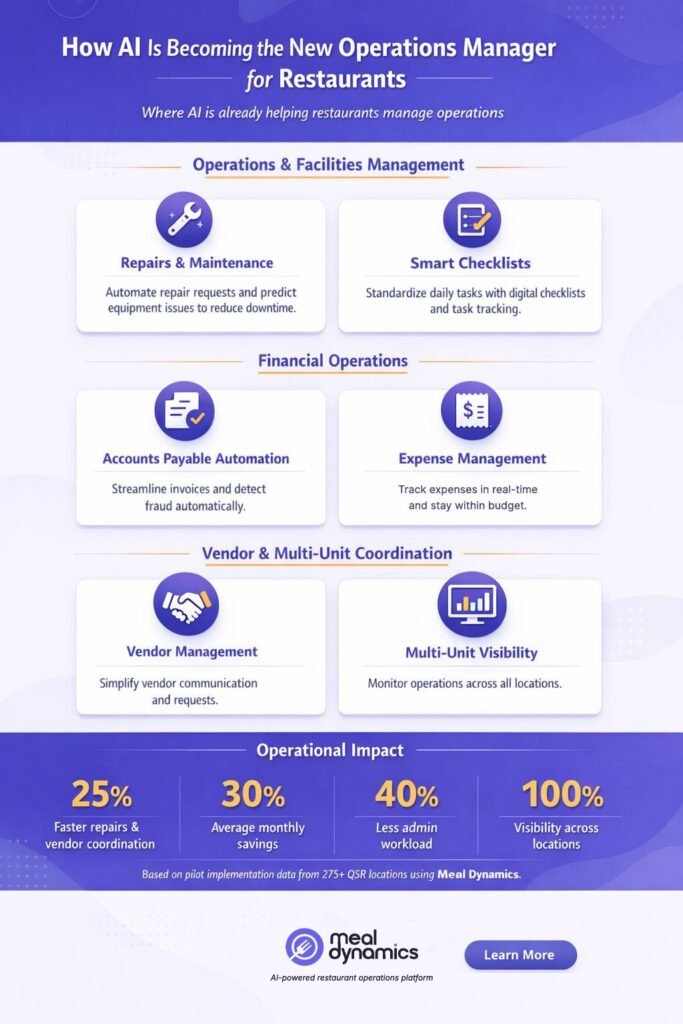
Instead of managing repairs, vendor communication, invoices, expenses, and operational tasks across multiple tools, these systems bring operational processes into one platform. Requests can be logged instantly, vendors can be assigned automatically, invoices can be scanned and routed for approval, and operational tasks can be tracked across locations.
This centralized approach helps restaurants replace fragmented workflows with structured operational systems.
Meal Dynamics is designed specifically for this purpose. Built by restaurant operators with decades of industry experience, it focuses on automating the operational work that often consumes managers’ time.
Restaurants using it can manage repairs and maintenance requests, coordinate vendors, automate accounts payable processes, track expenses, and assign operational tasks from a single dashboard. Powered by advanced Agentic AI, it helps organize the workflow while real-time reporting gives operators visibility across locations.
The result is not just another software tool. It becomes an operational layer that supports the responsibilities traditionally handled by restaurant operations managers.
Will AI Replace Restaurant Managers?
As artificial intelligence becomes more capable, many restaurant operators are starting to ask the same question: will AI eventually replace restaurant managers?
The reality is far more practical. Restaurants rely on human judgment, leadership, and team coordination in ways that technology cannot fully replicate. Managers handle guest experience, staff development, culture, and the countless real-world decisions that happen during a busy shift.
What AI can do is reduce the operational burden that often consumes a large part of a manager’s day.
Tasks like tracking maintenance requests, coordinating vendors, processing invoices, managing expenses, and monitoring operational tasks follow structured workflows. These are exactly the types of processes that AI systems are well suited to organize and automate.
By handling much of this operational coordination in the background, AI allows managers to spend less time on administrative work and more time leading their teams and improving the customer experience.
In that sense, AI is not replacing restaurant managers. It is helping them focus on the parts of the job that matter most.
As restaurants continue to adopt intelligent operational systems, the role of managers may evolve, but it will remain just as important.