
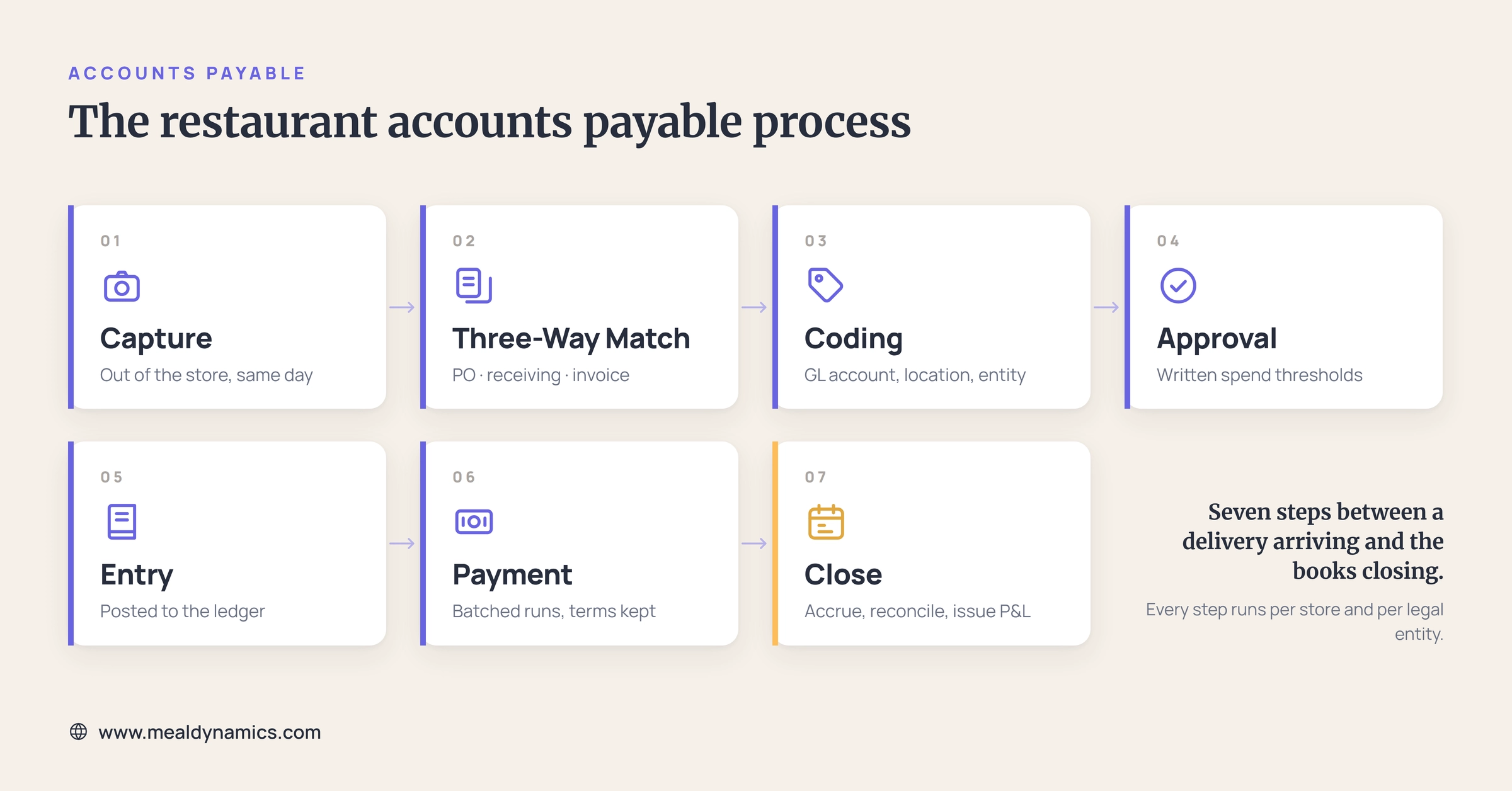
The restaurant accounts payable process turns a vendor delivery into a paid, correctly coded invoice through seven steps: capture, three-way match, GL and location coding, approval, entry, payment and close. In a multi-unit group every step has to work per store and per legal entity, or month-end numbers arrive too late to act on.
Table of Contents
Most operators can describe their ordering process in detail and their payables process not at all. Invoices arrive in a dozen ways — stapled to a delivery, emailed to a manager, mailed to a store that closed two years ago — and somebody sorts it out before the bank account gets hit. That works at one restaurant. It stops working somewhere around the fifth.
This is a walkthrough of what the restaurant accounts payable process actually contains, what breaks as unit count rises, which controls protect cash, and the handful of numbers worth tracking. It draws on published benchmarks and on Nadeem Bajwa, who operates more than 275 Papa John’s restaurants across 12 states through Bajco Group and has run an in-house accounting back office for over 20 years.
Why accounts payable decides whether your P&L is worth reading
Restaurant economics leave no room for a slow back office. The National Restaurant Association reports that 42% of operators said their restaurant was not profitable in 2025, and that total expenses have climbed 36% since 2019 — average hourly earnings up 41%, wholesale food prices up 35%. Before the pandemic, food and labor each consumed roughly 33 cents of every sales dollar against a typical margin near 5%. The margin has not grown since.
Nadeem Bajwa frames the same arithmetic the way an operator experiences it. Labor, food and cost of goods, he says, cover “probably 55 to 60, 65 percent of the cost — so that is extremely important that you want to look at every day.”
Nobody can look at it every day unless payables keep up. Nadeem Bajwa is blunt about the timeline:
“Your bills do not come in until a week or two after the month ends. But you want to wrap it up within a week or so, because whatever opportunities you see, you need to address them — you don’t want to wait two months from when those opportunities were there. Time is money.”
Nadeem Bajwa, Franchisee Wisdom Podcast
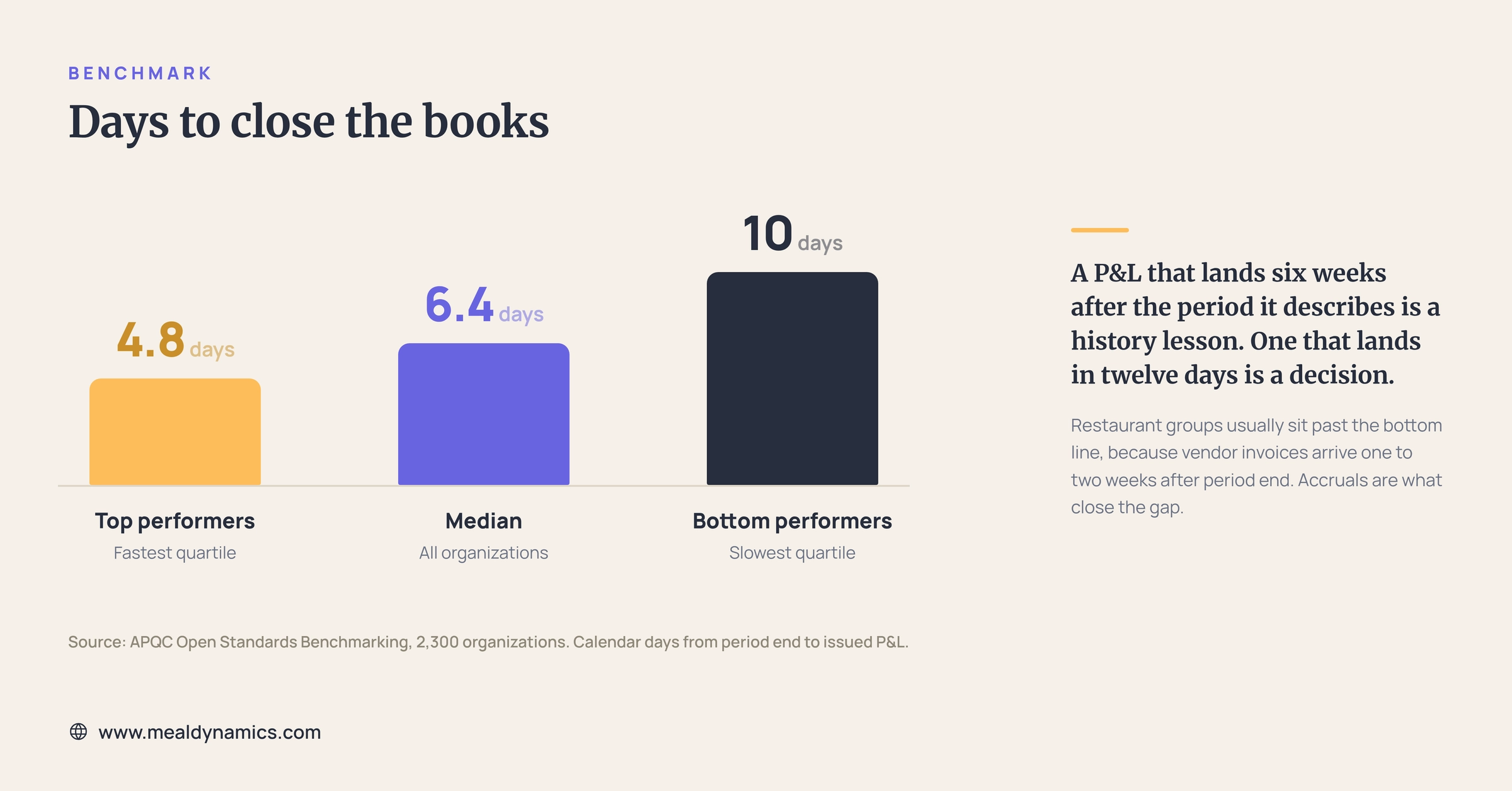
A P&L that lands six weeks after the period it describes is a history lesson. One that lands in twelve days is a decision. The difference is almost entirely an accounts payable problem. Or, as Nadeem Bajwa’s mentor John Schnatter used to put it: what gets measured, gets done.
The restaurant accounts payable process, step by step
Seven steps sit between a delivery arriving and the books closing. Most groups have all seven; the weak ones are just undocumented.
Capture
An invoice enters the process the moment a driver hands it over. Capture means getting a complete, legible copy out of the store and into a queue the same day — photographed at the back door, emailed by the vendor, or pulled from a supplier portal. Invoices that sit in a binder until the district manager’s next visit are the single most common cause of a late close.
Receiving and the three-way match
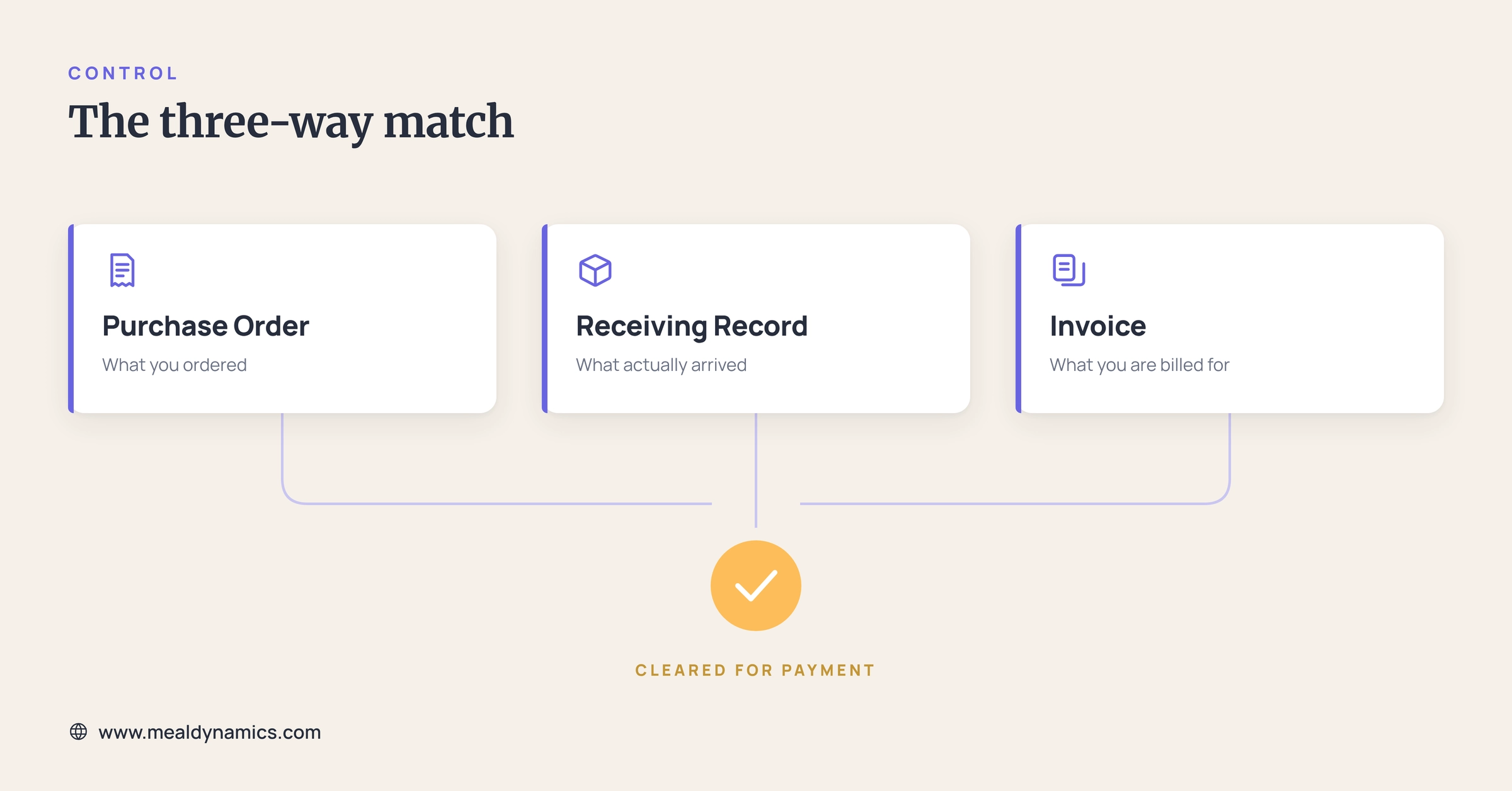
The three-way match compares the purchase order (what you ordered), the receiving record (what actually arrived) and the invoice (what you are being billed for). Short deliveries, substituted items and price changes between order and delivery are routine in foodservice, and the match is where they get caught. Skip it and credits are simply never claimed.
Coding to account, location and entity
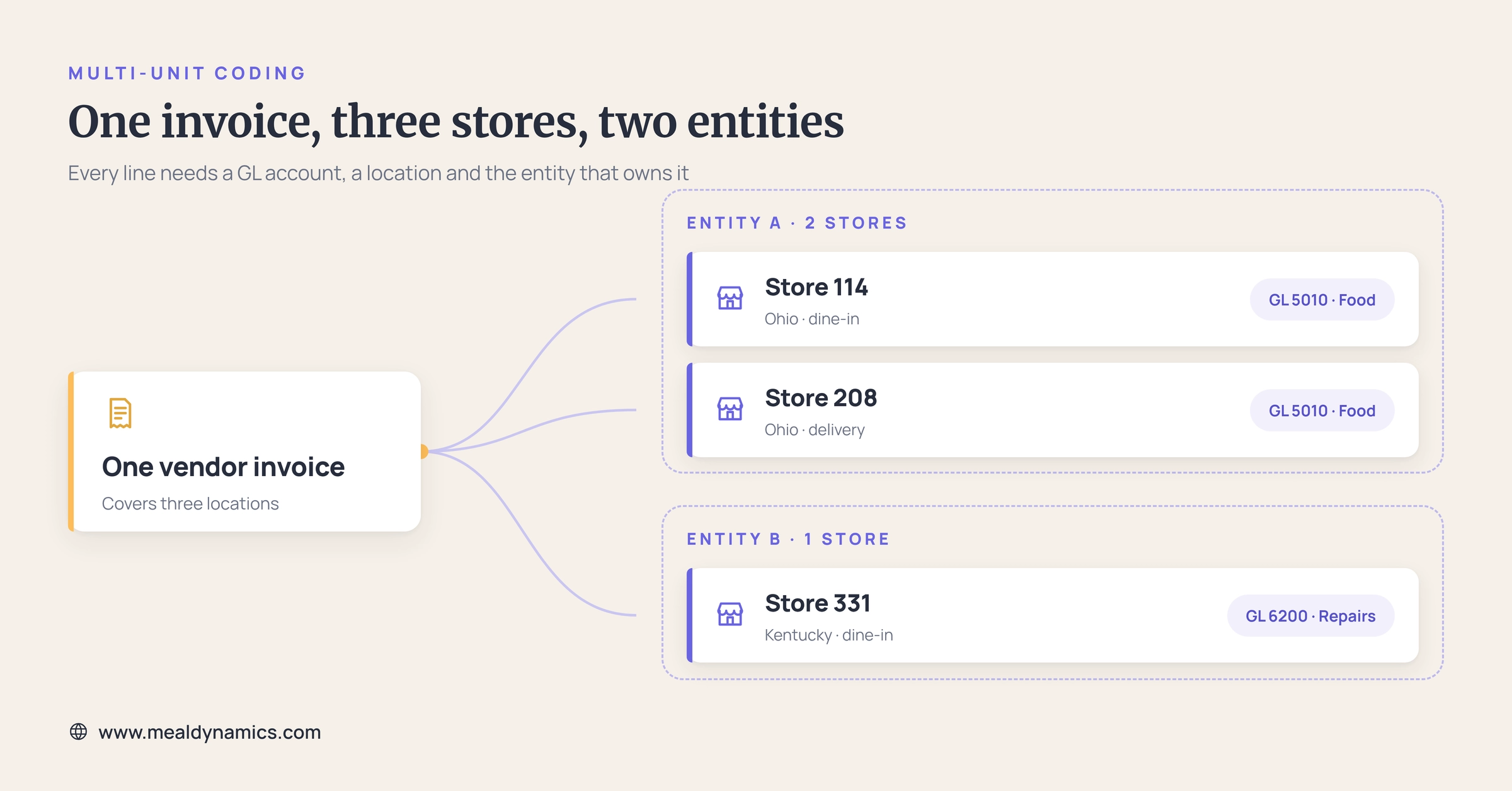
Every line needs a GL account, a location, and — in a franchise group — the legal entity that owns that location. This is where multi-unit accounts payable gets genuinely hard: one vendor invoice can cover three stores across two entities, and a miscoded invoice quietly distorts both P&Ls until someone reconciles it months later.
Approval routing
Approval answers one question: who is allowed to commit this money? Most groups run thresholds — a store manager clears routine food orders, a district manager clears repairs up to a limit, the controller or owner clears capital items. The written threshold matters more than the tool that enforces it.
Entry into the accounting system
The approved invoice posts to the ledger, whether that is NetSuite, QuickBooks, Sage Intacct or Microsoft Dynamics. Entry is where duplicate payments are either prevented or created, because a duplicate almost always enters twice under two slightly different spellings of the same vendor name.
The payment run
Terms, method and timing are decided as a batch, not invoice by invoice. Batching is what makes early-payment discounts capturable and late fees avoidable. It is also the highest-risk step in the whole process, which is why the controls section below exists.
Close, accrual and reconciliation
At period end, goods received but not invoiced are accrued, vendor statements are reconciled against the AP subledger, and the P&L is issued. Accruals are what let the close happen before every invoice has arrived — the mechanism that turns “bills come in a week or two late” from a blocker into a rounding adjustment.
What changes when you go from one restaurant to fifty
At one unit, the owner is the control. Nadeem Bajwa describes handling his own payroll by telephone: it took an hour a week, “because I was working 70, 80 hours a week also, so there was downtime.” Nothing is documented because nothing needs to be.
Growth removes that slack, and it removes it before the infrastructure arrives. “What I learned early on was that with growth, in order to scale, you have to be more efficient,” Nadeem Bajwa says. He and his host have a name for the stretch where this bites hardest — the “hell zone” of two to five units, where there are too many restaurants to hold in your head and not enough to justify a district manager.
Three things change structurally:
- Presence stops being verification. “When you go from one restaurant to two, three, four, then real-time data is the most critical item, because you’re not in that building every day managing, you’re in multiple places.”
- Coding gains a second dimension. Entity structure, multi-state operations and shared vendors mean an invoice is no longer just an expense — it is an expense belonging to a specific store inside a specific entity.
- Approvals have to be delegated without being abandoned. One of Nadeem Bajwa’s field leaders runs 104 restaurants; nobody reviews every invoice at that scale, so thresholds and exception reports replace personal review.
His warning to operators in the 15-to-20 unit range is about tool sprawl rather than tools. Where people make a mistake, he says, “is they end up getting multiple solutions, and that increases their work… find the platform that have multiple tasks done, rather than having multiple portals, multiple solutions.” Every extra portal adds a login, a reconciliation and a per-store-per-month fee — the same pattern that shows up across all the back-office tasks that slip through the cracks.
Where the restaurant accounts payable process usually breaks
Six failure points account for most of the damage. None of them are exotic.
Break point | What it looks like | What it costs |
Invoice capture | Paper stacks in the store office; invoices surface after close | Late accruals, restated P&Ls |
No three-way match | Short deliveries billed in full; price creep unnoticed | Unclaimed credits, silent COGS inflation |
Coding by memory | One person knows the GL and entity map | Miscoded stores, unusable variance reports |
Approval bottleneck | Every invoice waits on one owner | Late fees, lost discounts, strained vendors |
Duplicate vendor records | “Sysco” and “Sysco Foods” both active in the master | Duplicate payments |
Manual payment run | Checks cut and signed at the office | Highest-exposure fraud channel |
Repairs deserve a special mention. Unlike food, repair invoices arrive irregularly, from vendors nobody has a contract with, for work nobody at head office witnessed — which is why repair and maintenance spend is where uncontrolled cost most often hides in a multi-unit group.
The controls that keep cash where it belongs
Accounts payable is where money physically leaves the business, which is why it attracts fraud. The Association for Financial Professionals surveyed 465 treasury practitioners in January 2026 and found that 76% of US organizations faced attempted or actual payments fraud during 2025. Checks remained the most-targeted method at 58%, and 74% of organizations were hit by business email compromise — typically an email asking AP to update a vendor’s bank details. Just 17% use AI in any form to fight it.
Four controls carry most of the weight:
- Segregation of duties. Whoever approves an invoice should not also be able to add the vendor and release the payment. At low unit counts this is the hardest control to staff and the most important one to write down.
- A locked vendor master. Bank detail changes require out-of-band verification — a call to a number you already had, never a reply to the email making the request.
- Exception reporting instead of blanket review. Flag invoices outside tolerance, brand-new vendors, round-number amounts and out-of-pattern volumes. Reviewing everything means reviewing nothing.
- Retention. The IRS requires records supporting a return to be kept until the period of limitations expires — generally three years, six if income was understated by more than 25%, and four years for employment tax records. Digital capture solves retention as a side effect.
The accounts payable metrics worth tracking
Six numbers tell you whether the process is healthy. The first three have published benchmarks; the rest are only useful as your own trend line.
Metric | How to calculate it | Benchmark |
Cost per invoice | Fully loaded AP cost ÷ invoices processed | $12.88 average (Ardent Partners) |
Invoice cycle time | Receipt to approved-for-payment | 17.4 days average without automation |
Days to close | Period end to issued P&L | 6.4 median · 4.8 top · 10 bottom (APQC) |
First-pass match rate | % of invoices clearing with no exception | Track your own trend |
On-time payment rate | % of invoices paid within terms | Track your own trend |
Invoices per AP FTE | Annual invoice volume ÷ AP headcount | Track your own trend |
Source: Ardent Partners figures via Bottomline; close benchmarks from APQC Open Standards Benchmarking (2,300 organizations).
Nadeem Bajwa’s own test is simpler than any of these, and better:
“If I went back, I would just look for something — a platform — that would give me one report, a one-pager, that I could print in 15 to 20 seconds and spend 15 to 20 minutes on, and spend the rest of my time being more productive.”
Nadeem Bajwa, Franchisee Wisdom Podcast
If producing that one page takes your team a week of chasing, the problem is not reporting. It is payables.
A 30-day diagnostic for your AP process
Run these seven checks on your restaurant accounts payable process before evaluating any software. Most groups find two or three answers they do not like.
- Pull the last closed month and count the days from period end to issued P&L. That is your days-to-close.
- Take 20 random invoices and time how long each took from delivery date to approval. The spread matters more than the average.
- Export your vendor master and sort alphabetically. Count near-duplicate names.
- Ask who can add a vendor, approve an invoice and release a payment. If any one person can do all three, fix that first.
- Check how many invoices in the last quarter were paid after their due date, and what that cost in fees or lost discounts.
- Count the separate portals your team logs into to close a month.
- Ask one district manager how they know a repair invoice is legitimate. If the answer is “I remember approving it,” you do not have a control.
Frequently asked questions
What is the restaurant accounts payable process?
It is the sequence that takes a vendor invoice from delivery to payment and into the books: capture, three-way match against the order and receiving record, coding to a GL account and location, approval, entry into the accounting system, the payment run, and period-end accrual and reconciliation. Multi-unit groups add a legal entity to the coding step.
What is a three-way match in a restaurant?
A three-way match compares the purchase order, the receiving record and the vendor invoice before payment is approved. In foodservice it catches short deliveries, substituted products and price changes between order and delivery. It is the main defense against paying for food that never arrived, and the reason credits get claimed at all.
How long should a restaurant group take to close the books?
APQC benchmarking of 2,300 organizations puts the median close at 6.4 calendar days, with top performers at 4.8 days and bottom performers at 10. Restaurant groups are often slower because vendor invoices arrive one to two weeks after period end — which is exactly what accruals exist to handle.
How much does it cost to process a single invoice?
Ardent Partners puts the average at $12.88 per invoice, with an average cycle time of 17.4 days for organizations without automation. Multiply by your monthly invoice volume across every location before deciding the number is small. For a 50-unit group running 40 invoices per store per month, that is roughly $26,000 a month.
How long do restaurants need to keep vendor invoices?
The IRS requires records supporting a tax return to be kept until the period of limitations expires — generally three years, extending to six if income was understated by more than 25%, and four years for employment tax records. Check insurer and lender requirements too, as they are sometimes longer.
Who should approve invoices in a multi-unit restaurant group?
Use written thresholds rather than a single approver. A common structure: store managers approve routine food and supply orders, district managers approve repairs and services up to a set limit, and the controller or owner approves capital spend and anything from a new vendor. Whoever approves should never also be able to release payment.
Where to start
Measure two numbers this month — cost per invoice and days to close — and you will know whether your restaurant accounts payable process is holding the business back or keeping up with it. Fix capture first, because every other step inherits its delay, then write down your approval thresholds. Only after that does it make sense to look at AP automation software built for restaurants, or at what cutting invoice processing costs is actually worth to a group your size. Operators earlier in the journey may find it useful to read how new QSR franchise owners operate efficiently before building the process out.
Nadeem Bajwa’s closing advice on technology applies equally to the process it runs on: “Simplicity is the best policy… it should not be a burden on your team and yourself.”